Getting to Chocó is not that easy. Located in western Colombia, it is the only department in the country with coasts in both oceans. Washed by the Atlantic in its northern part and by the Pacific in the southern part, it is despite its infinite natural wealth, the poorest department of Colombia.
This new one-week adventure has as its final destination at the beaches of Guachalito in the village of Joví, Gulf of Tribugá, about 40 minutes by speedboat from Nuquí. And how do you get to Nuquí? Some logistics are required. From Bogotá there are no direct flights, one way is to make there is a stopover in Medellín and then fly from the Olaya Herrera airport in a charter plane.
The flight time is very short, about 30 minutes, first passing over the mountains of the Western Cordillera and then encountering the majesty of the Chocó jungle, the rainiest rainforest on the planet. Framed by the Atrato and San Juan rivers, it’s a landscape full of contrasts; right next to the jungle, all that green ends up colliding with the imposing Pacific Ocean. However, like any flight in light aircraft without pressurized cabin, certain situations arise. This case was no exception. At the beginning of the descent, due to the change in pressure, our ears began to ache, pain that was diminished as we ingested large amounts of water and approached land.
Getting to Nuquí is literally reaching another world. The airport has a capacity to receive airplanes of a maximum of 19 people and despite being part of Colombia, it is necessary to make a kind of “immigration” process to enter. With just over 8,000 inhabitants Nuquí is caught between the jungle and the sea. You can only reach Nuquí by plane or directly by sea. Having no land access, there are no cars in Nuquí, only motorcycles and Tuk-Tuk type motorcycle taxis (auto rickshaws).
Nuquí welcomed us with a splendid sun. There, Benjamin, our host and guide, was waiting for us. Five minutes later, on the way to the dock to take the boat, it was pouring rain. We cannot forget that we were in the rainiest place in the world. Leaving from the pier located on the Nuquí River and on our way to our final destination, we witnessed the contrast between the great natural wealth and the poverty of the place.
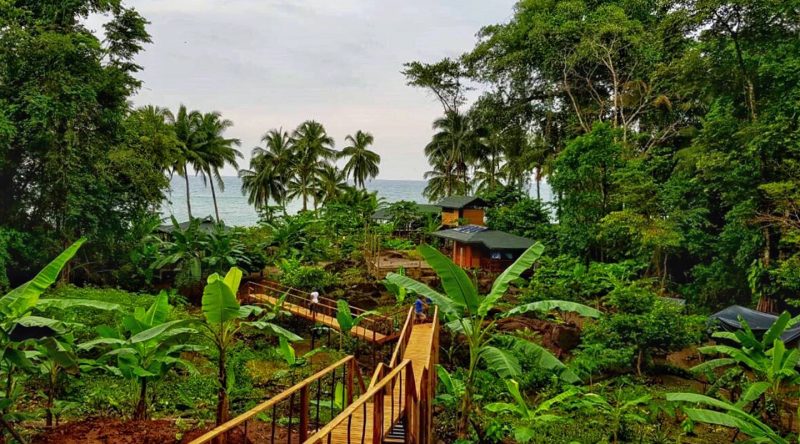
40 minutes later, 20 of which were under a torrential downpour, we arrived to our final destination, the beaches of Guachalito. The beauty of the place is shocking. Endless dark color beaches, which divide the green jungle and the infinite Pacific in two. Also impressive are the promontories that emerge above the sea level to form small islets that are covered with vegetation and on which several species of seabirds nest. In addition to their stunning beauty, some of these beaches are also important nesting sites for sea turtles.
Once there, we were greeted by our other hostess, Elizabeth, with a delicious juice of tropical fruits. And then, for the cabin to leave the luggage. The hotel is very simple and spectacular at the same time. Virtually located on the beach, the wooden cabin had 2 exquisitely arranged beds each with a kind of white mosquito net veil (although there are no mosquitoes in this place), a spectacular bathroom with an open-air shower and a balcony with a hammock and with the most spectacular ocean view. The perfection and beauty of the simple…
If Nuquí is isolated, there is nothing here; neither electricity nor television signal; the only way is through the satellite. Amazingly, they have DIRECTV only to watch the news and the soup opera. About a hundred channels to see only one of them and also occasionally. And the very best of it, almost no cell signal; to get some signal you have to climb one of the rocky headlands, located in the southern corner of the place. Everything is so difficult here, that even trips on Benjamin’s boat are limited. Gasoline arrives by ferry from Buenaventura to Nuquí, on a trip of more than 7 hours, once a week. Therefore it is in short supply and therefore quite expensive.
Everything is so perfect that even the hotel is completely self-sustainable. The water, which is not limited here, comes by gravity directly from the jungle. Electricity is generated through solar panels. The food comes directly from the garden; fruits, vegetables, herbs, tubers, cereals; everything you need is there. From the farm, eggs, milk, cheese. And the best of all, the richness and variety that the sea has to offer; sierra, snapper, tuna, hake, weevil, dorado, horse mackerel, the variety is infinite; always in an artisanal way and guaranteeing sustainable and responsible fishing at all times. The generosity of the land and the sea combined to give the best of the best, the most delicious variety of local cuisine … We were so delighted with the menu, that the day Elizabeth proposed to kill us a chicken to change the fish menus, the resounding no from everyone was unanimous…
Being surrounded by so much wealth puts one to think about the contrast so evident that one sees when arriving to Nuquí. ¿How is it possible that there is poverty on this land? It’s simply inconceivable.
Our first night arrived, dinner, the news and going to bed. 8:00 at night and we were ready to sleep. The only sounds, the cooing of the sea a few meters from the cabin and the soft whisper of the wind that cooled the place. No heat, no mosquitoes, nor anything else…
Getting to Chocó is not that easy, but any small inconvenience is worth it, just to be able to enter its magical natural wealth.